



Yes, our inventory is accurate!
 Qualifies for Free Ground Economy Shipping (CONUS Only)
A 4/3-inch mono camera with big pixels for narrowband, and a 47MP mode for fine detail
Why we like the ASI294MM Pro:
- Two cameras in one: by default it works as an 11.7MP camera with large 4.63µm pixels and a 66,000e⁻ full well. Switch to ZWO's unlocked Bin1 mode in your capture software and the same sensor becomes a 47MP camera with 2.3µm pixels for short refractors and lenses.
- Sensitive where it counts: the back-illuminated Sony IMX492 peaks at about 90% QE, and read noise drops to about 1.2e⁻ once gain reaches 120, which suits faint hydrogen-alpha, OIII and SII targets.
- Easy on filters: the 23.2mm diagonal sensor is smaller than APS-C, so 1.25-inch or 31mm filters in an 8-position wheel work at f/5 and slower, which keeps a full LRGB plus narrowband set affordable.
- Worth knowing: this sensor shows some amp glow in the corners and a faint pattern on stretched images. Both calibrate out with matching dark and flat frames, so plan on taking them. You'll also need 12V power and a computer or ASIAIR to run it.
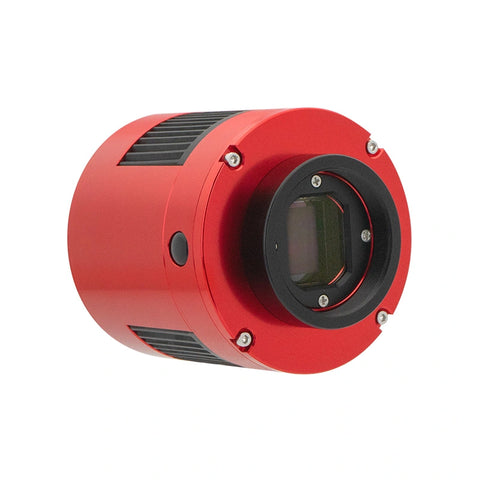
The ZWO ASI294MM Pro is a cooled monochrome astronomy camera built on Sony's back-illuminated 4/3-inch IMX492 sensor. It's a good first mono camera for imagers ready to move up from color, and it pairs naturally with refractors from about 250 to 800mm. Two-stage cooling holds the sensor about 35°C below ambient, a 14-bit ADC gives about 13 stops of dynamic range, and a USB 3.0 connection with a DDR3 buffer keeps downloads reliable. The round red body is 78mm across.
Key specs: Sony IMX492 mono sensor, 4/3-inch, 19.1 × 13.0mm · 11.7MP (4144 × 2822) at 4.63µm, or 47MP (8288 × 5644) at 2.3µm in Bin1 mode · about 90% peak QE · 14-bit ADC, about 13 stops dynamic range · read noise as low as 1.2e⁻ · 66ke⁻ full well (Bin2) · two-stage cooling about 35°C below ambient · USB 3.0 with DDR3 buffer and 2-port USB 2.0 hub

What you can image
- Large nebulae in narrowband: the North America and Pelican, the Heart Nebula, the Veil and the California Nebula in hydrogen-alpha, OIII and SII. On a 250mm RedCat 51 the field is about 4.4° × 3.0° at 3.8″ per pixel, or 1.9″ per pixel in Bin1 mode.
- Nebula detail: the Eagle's Pillars, the Elephant's Trunk, the Crescent and the Cygnus Wall. On the 490mm ZWO FF70 the field is about 2.2° × 1.5° at 1.95″ per pixel.
- Galaxies in LRGB: M81 and M82, the Leo Triplet, the Whirlpool and the Triangulum Galaxy. On the 612mm FF90 the field is about 1.8° × 1.2° at 1.56″ per pixel.
- Bright clusters and the Moon: short exposures of the Pleiades, the Double Cluster or lunar mosaics, where the 47MP mode adds resolution on short focal lengths.
How it works
A mono camera records every pixel at full sensitivity and leaves color to filters. A filter wheel in front of the camera switches filters during the night, and software combines each filter's frames into a color image. The camera connects to a computer or an ASIAIR Plus over USB 3.0 and needs 12V power to be recognized and to run its cooler (ZWO recommends 12V at 3–5A, 5.5 × 2.1mm plug, center positive, or an 11–15V lithium battery). Two USB 2.0 ports on the back power and control a filter wheel and guide camera, which keeps cables short at the scope.
Bin2 or Bin1? The standard mode (4.63µm pixels, 14-bit, 66ke⁻ full well) is the one to use on most refractors. The unlocked Bin1 mode (2.3µm pixels, 12-bit, 14.4ke⁻ full well, 5.7 fps) helps only on short focal lengths where the larger pixels would undersample, and its files are about four times bigger.
The sensor sits 6.5mm behind the camera's front, or 17.5mm with the included 11mm T2 ring fitted. The included extenders bring that to the 55mm most flatteners and reducers expect, as ZWO's chart below shows, with or without an off-axis guider.

Using it in Colorado
- Front Range skies: narrowband filters cut through city light, so emission nebulae are fair game from Denver. Save LRGB galaxies for darker sites like Jackson Lake State Park or the Westcliffe area.
- Moonlit nights: hydrogen-alpha is barely affected by the Moon, which turns nights most color imagers lose into productive ones.
- Cold nights: the cooler holds a set temperature as the night cools off. ZWO's sealed sensor chamber resists dew, but on humid nights a dew heater on the telescope still helps.
What to add for the best results
- A filter wheel (required for color): the ZWO EFW 8x1.25" (2025) holds eight 1.25-inch or 31mm filters, enough for LRGB plus SHO with a spare slot. On faster scopes the EFW 7x36mm (2025) gives more margin against vignetting.
- Filters (required for color): the Optolong LRGB + SHO 7nm set (1.25" or 36mm unmounted), or start with the ZWO 7nm SHO set for narrowband and add the ZWO LRGB set later.
- 12V power (required): the ZWO 12V 5A adapter at home, or a PowerTank Lithium Pro in the field.
- ZWO OAG with an ASI220MM Mini guide camera: guides through the main telescope, which suits longer focal lengths. A ZWO 30F5 guide scope works well on shorter refractors.
- ZWO EAFN electronic focuser: refocuses automatically after filter changes and as the temperature drops.
- ASIAIR Plus: runs the camera, filter wheel, mount, guiding and focuser from your phone, including multi-filter sequences.
- A mount: the ZWO AM5N carries this camera, a filter wheel and a refractor up to about 110mm with room to spare.
ASI294MM Pro vs. ASI294MC Pro vs. ASI533MM Pro vs. ASI2600MM Pro
| ASI294MM Pro | ASI294MC Pro | ASI533MM Pro | ASI2600MM Pro (2025) | |
|---|---|---|---|---|
| Sensor | IMX492 mono, 4/3" | IMX294 color, 4/3" | IMX533 mono, 1" square | IMX571 mono, APS-C |
| Sensor size | 19.1 × 13.0mm | 19.1 × 13.0mm | 11.3 × 11.3mm | 23.5 × 15.7mm |
| Resolution | 11.7MP (47MP in Bin1) | 11.7MP | 9MP | 26MP |
| Pixel size | 4.63µm (2.3µm in Bin1) | 4.63µm | 3.76µm | 3.76µm |
| Amp glow | Some, removed with darks | Some, removed with darks | None | None |
| Filters needed | 1.25", 31mm or 36mm filters and a filter wheel | None (UV/IR cut recommended) | 1.25" filters and a filter wheel | 36mm or 2" filters and a filter wheel |
| Best for | Wide narrowband fields on a budget, with big pixels for longer scopes | Color in one shot on the same sensor size | Compact square framing, clean data | Bigger fields and finer pixels, on scopes that cover APS-C |
See all ZWO cooled deep-sky cameras.
What's in the box

- ASI294MM Pro camera body, front cover and camera bag
- T2-M48 extender (16.5mm), T2 extender (21mm) and M42-M48 adapter
- 1.25-inch nosepiece and T2-1.25" adapter
- Four spacers (0.1mm, two at 0.2mm and 0.5mm)
- USB 3.0 cable (2m) and two USB 2.0 cables (0.5m)
- Quick guide
The 12V power supply, filter wheel, filters and guide camera are sold separately.
ZWO ASI294MM Pro FAQ
Is the ASI294MM Pro good for beginners?
It's best as a second camera, after you've learned focusing, guiding and stacking with a color camera. If this is your first dedicated astro camera, the ASI294MC Pro uses the same size sensor in color and needs no filter wheel.
Mono (MM) or color (MC)?
Choose the MC Pro for color images in one shot and a simpler setup. Choose the MM Pro to shoot narrowband from the city or pull the most signal from each hour, if you're ready to add a filter wheel and filters.
Do I need 1.25-inch, 31mm or 36mm filters?
The 23.2mm diagonal sensor works with 1.25-inch or 31mm filters in an 8-position wheel on scopes at f/5 and slower; ZWO sells this camera in a kit with exactly that. On faster scopes, 36mm filters in the EFW 7x36mm avoid darkened corners.
Does the ASI294MM Pro have amp glow?
Yes, a little in the corners of long exposures, and stretched images can show a faint pattern. ZWO notes both are characteristics of this sensor and calibrate out with dark and flat frames taken at the same gain and temperature.
ASI294MM Pro or ASI2600MM Pro?
The ASI2600MM Pro covers about 1.5 times the area with smaller pixels, a 16-bit ADC and no amp glow, but needs 36mm or 2-inch filters and a scope that covers APS-C. The ASI294MM Pro costs less, uses smaller filters, and its larger pixels match longer focal lengths well.
What power and accessories do I need?
12V power (3–5A), a USB 3.0 port on a computer or an ASIAIR, a filter wheel and filters for color, and a way to guide. The camera won't connect without 12V power, even with the cooler off.
Specifications
| Sensor | |
|---|---|
| Sensor | Sony IMX492, back-illuminated, monochrome |
| Format | 4/3-inch, 19.1 × 13.0mm (23.2mm diagonal) |
| Resolution | Bin2 (standard): 11.7MP, 4144 × 2822; unlocked Bin1: 47MP, 8288 × 5644 |
| Pixel size | 4.63µm (Bin2); 2.3µm (Bin1) |
| ADC | 14-bit (Bin2); 12-bit (Bin1) |
| Full well | 66ke⁻ (Bin2); 14.4ke⁻ (Bin1) |
| Read noise | As low as 1.2e⁻ (high-conversion-gain mode at gain 120 and up) |
| Dynamic range | About 13 stops |
| Peak QE | About 90% |
| Performance | |
| Cooling | Two-stage TEC, about 35°C below ambient (measured at 30°C ambient) |
| Dark current | 0.0022e⁻/s/pixel at −20°C |
| Max frame rate | 16.3 fps (14-bit) or 19 fps (12-bit) at 11.7MP; 5.7 fps in Bin1 |
| Amp glow | Some, calibrated out with dark frames |
| Physical and connections | |
| Data | USB 3.0 with DDR3 buffer (512MB per ZWO's spec table) |
| Hub | 2 × USB 2.0 on the camera body |
| Power | 12V DC, 3–5A, 5.5 × 2.1mm center positive, or 11–15V lithium battery (not included); required for the camera to connect |
| Back focus | 6.5mm; 17.5mm with the included 11mm T2 ring; 55mm with the included extenders |
| Front connection | M42 × 0.75 (T2); included adapters fit M48 and 1.25" nosepiece |
| Body diameter | 78mm |
| Warranty | 2 years (ZWO) |
| Model / SKU | ZWO-ASI294MM-P |