



 Qualifies for Free Ground Economy Shipping (CONUS Only)
A fast 160mm imaging Newtonian that a mid-size mount can carry
Why we like the Askar N160:
- Fast without the bulk: f/3.4 gathers signal quickly, and at 5.2kg (11.5lb) with rings, handle, dovetail and corrector it's light enough for the same class of mount that carries a 100mm refractor.
- Everything for round stars: Askar includes its 2" 0.95× triplet coma corrector, an M58-to-M48 adapter and spacing shims, so stars stay round to the edges of an APS-C sensor without buying a separate corrector.
- A useful focal length: 544mm sits between wide-field refractors and long-focus scopes, big enough for galaxy groups and nebula detail, wide enough for the Rosette or the Veil.
- Worth knowing: like any fast Newtonian it needs collimation, and at f/3.4 the tolerance is tight. The 28mm image circle is sized for APS-C and smaller sensors, not full frame, and the secondary mirror's spider adds diffraction spikes to bright stars.
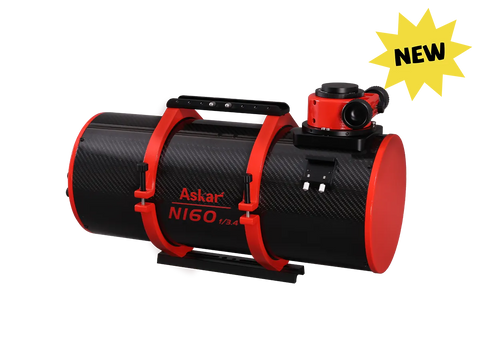
The Askar N160 Newtonian Astrograph is a 160mm (6.3") f/3.4 reflector made for deep-sky astrophotography. A parabolic primary mirror and Askar's included 0.95× triplet coma corrector give a 544mm focal length with a standard 55mm back focus from an M48 thread, and the carbon fiber tube is only 467mm (18.4") long. It's a cost-effective way to get more aperture and speed than a small refractor, and the smaller sibling of the Askar N210.
Key specs: 160mm aperture · 544mm focal length, f/3.4 with the included corrector (576mm, f/3.6 without) · parabolic primary · 0.95× triplet coma corrector · APS-C (28mm) image circle · 55mm back focus from M48 · carbon fiber tube · 5.2kg (11.5lb) with rings, handle, dovetail and corrector

What you can image
- Nebulae: with an APS-C camera the N160 frames about 2.5° × 1.6°, enough for the Rosette Nebula, the Western Veil, the Pelican Nebula, the Cygnus Wall in the North America Nebula and the Omega Nebula, several of them targets in Askar's own N160 sample images.
- Galaxies: the Triangulum Galaxy, Bode's and the Cigar Galaxies together, the Leo Triplet and the Whirlpool Galaxy.
- Clusters: the Double Cluster in Perseus just fits, and globulars such as M13 and M3 show their outer stars quickly at f/3.4.
- Narrowband: the fast focal ratio makes hydrogen-alpha and oxygen imaging with a mono camera much quicker than with a slower refractor.
With a 26MP APS-C camera such as the ZWO ASI2600MC Pro, the N160 works at about 1.43 arcseconds per pixel, a good match for typical Colorado seeing.
How it works
Optics: the parabolic primary mirror forms the image, and the 2" triplet coma corrector removes the comet-shaped edge stars that every fast Newtonian shows on its own. The corrector also trims the focal length from 576mm to 544mm, for f/3.4.
Connecting a camera: thread your camera onto the corrector's M48 × 0.75 thread and set the sensor 55mm behind it, which most astronomy cameras reach with their own spacers. Askar includes 0.1mm, 0.2mm and 0.3mm shims to fine-tune the spacing.
Mounting: the tube rings hold a 230mm dovetail plate below and a multifunctional handle across the top.
Collimation: a Newtonian's mirrors need aligning from time to time, and at f/3.4 it pays to check before each session. Once you've learned it, it takes a few minutes, and we're happy to show you how.

What to add for the best results
- A mount (required): plan on about 6.5kg (14lb) with a camera, focuser and guide scope. The ZWO AM5N carries it with plenty to spare and no counterweight, or choose a counterweighted mount such as the Sky-Watcher HEQ5 or EQ6-R Pro. Star trackers and small GoTo mounts can't carry it.
- A camera (required): an APS-C cooled camera such as the ZWO ASI2600MC Pro (2.5° × 1.6°), the ASI2600MC Air with a built-in guide sensor and ASIAIR, or the ASI533MC Pro for a square 1.2° × 1.2° field.
- Guiding: the Askar 32mm f/4 guide scope or ZWO 30F5 with a ZWO ASI120MM Mini guide camera.
- Control: the ZWO ASIAIR Plus runs the camera, mount, guiding and focuser from your phone or tablet.
- Autofocus: a ZWO EAFN keeps a fast mirror sharp as the night cools. Askar publishes an electronic focuser assembly diagram for the N160, and we can help you fit it.
- Filters: a 2" ZWO Duo-Band or Optolong L-eXtreme filter for emission nebulae from suburban skies.
Askar N160 vs. N210
| Askar N160 | Askar N210 | |
|---|---|---|
| Aperture | 160mm (6.3") | 210mm (8.3") |
| Focal length with corrector | 544mm, f/3.4 | 714mm, f/3.4 |
| Field with APS-C (ASI2600MC) | 2.47° × 1.65° | 1.89° × 1.26° |
| Image scale (3.76µm pixels) | 1.43″/pixel | 1.09″/pixel |
| Tube diameter × length | 193 × 467mm | 264 × 640mm |
| Weight with rings, handle, plate and corrector | 5.2kg (11.5lb) | 9.8kg (21.6lb) |
| Dovetail plate | 230mm | 400mm |
| Best for | Wider nebulae on a mid-size mount | Galaxies and nebula detail on a heavy-duty mount |
See all Askar telescopes.
What's in the box
- Askar N160 optical tube
- Pair of tube rings
- 230mm dovetail plate
- Multifunctional handle
- 0.95× coma corrector (2")
- M58 to M48 adapter
- Spacing shims: 0.1mm, 0.2mm and 0.3mm, two of each
- Manual
The mount, camera, guide scope, focuser motor and filters are sold separately.
Askar N160 FAQ
Is the N160 good for a beginner?
It's a good second telescope. If you've already imaged with a small refractor and are comfortable with guiding, the N160 is a big step up in light and detail. If you're just starting, a self-flattened refractor such as the Askar 60F is more forgiving, with no collimation to learn.
What mount do I need?
Something rated for at least 10kg (22lb) for imaging. The ZWO AM5N, Sky-Watcher HEQ5 or EQ6-R Pro all work.
N160 or N210?
The N160 weighs about half as much, fits on a mid-size mount and frames a wider field for big nebulae. The N210 collects about 70% more light and its 714mm focal length suits galaxies, but it needs a heavier mount.
Which camera works best?
An APS-C or smaller astronomy camera with 55mm of back focus, such as the ASI2600MC Pro or ASI533MC Pro. The corrector covers a 28mm circle, so full-frame sensors will show dark, soft corners.
Can I use it for visual observing?
Askar designed the N160 as an astrograph and supplies only camera adapters. For viewing and imaging with one telescope, a refractor like the Askar 91F is a better choice.
Does the coma corrector come with it?
Yes. The 2" 0.95× triplet coma corrector is included, along with the M58-to-M48 adapter and spacing shims.
Specifications
| Optics | |
|---|---|
| Optical design | Newtonian reflector, parabolic primary mirror, with triplet coma corrector |
| Aperture | 160mm (6.3") |
| Focal length | 544mm with corrector; 576mm without |
| Focal ratio | f/3.4 with corrector; f/3.6 without |
| Coma corrector | 0.95× triplet, 2" |
| Image format | APS-C (28mm image circle) |
| Secondary mirror minor axis | 61mm |
| Resolution | 0.73″ |
| Mechanical | |
| Camera thread | M48 × 0.75 on the corrector |
| Back focus | 55mm from the M48 thread |
| Tube | Carbon fiber; 193mm (7.6") outside diameter, 467mm (18.4") long |
| Mounting | Pair of tube rings, 230mm dovetail plate, multifunctional handle |
| Weight | |
| Optical tube | 3.97kg (8.8lb) |
| With rings, handle, dovetail and corrector | 5.2kg (11.5lb) |
| Corrector | 0.22kg (0.5lb) |
| Model / SKU | Askar N160 |