



Yes, our inventory is accurate!
 Qualifies for Free Ground Economy Shipping (CONUS Only)
A 6-inch WiFi telescope with a built-in battery
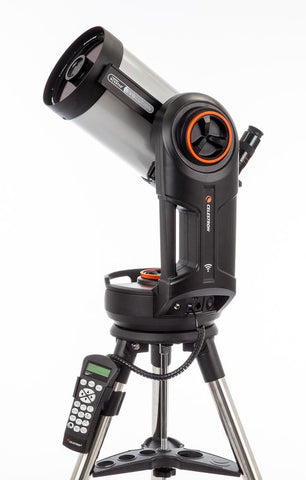
The Celestron NexStar Evolution 6 pairs a 6-inch (150mm) Schmidt-Cassegrain with Celestron's most user-friendly computerized mount. Control it from your phone or tablet over built-in WiFi, observe for about 10 hours on the built-in rechargeable battery, and swing it by hand anytime thanks to manual clutches on both axes. At 38 lbs for the whole kit, it's the lightest and easiest Evolution to carry out in one trip.
Why choose the NexStar Evolution 6
- No batteries or power cords in the field: the built-in lithium battery runs about 10 hours, and a USB port charges your phone.
- WiFi control: find and track objects with the free SkyPortal app, or use the included NexStar+ hand control.
- Manual clutches: point the telescope by hand without losing alignment.
- Sturdier mount: brass worm gears and a heavier-duty fork arm than the NexStar SE, so the view settles faster when you focus.
What you'll see
- The Moon: craters, mountain ranges and valleys in crisp detail.
- Planets: Saturn's rings, Jupiter's cloud bands and four largest moons, the phases of Venus, and Mars's polar caps when it's close to Earth.
- Deep sky: the Orion Nebula, the Ring Nebula, globular clusters like M13, and bright galaxies such as Andromeda.
What to add for the best views
The Evolution 6 comes with 40mm (38x) and 13mm (115x) eyepieces, a good start. For the Moon and planets, a slightly higher power of about 125x to 170x shows more detail on typical nights, and better eyepieces add a wider field and more comfortable viewing.
- Higher power: the Celestron X-Cel LX 9mm gives 167x and the Celestron X-Cel LX 12mm gives 125x, both with 16mm of eye relief and a 60° field. For a step up in sharpness and comfort, the Tele Vue 9mm DeLite (167x) and Tele Vue 11mm DeLite (136x) have 20mm of eye relief, great for eyeglass wearers.
- Mid power: the Celestron X-Cel LX 18mm gives 83x, a great power for globular clusters and small nebulae.
- Widest views: the Tele Vue 24mm Panoptic gives 63x with the widest field a 1.25-inch eyepiece can show, framing the Pleiades and large star clusters with pinpoint stars to the edge.
- A Moon filter: a variable polarizing filter dims the bright Moon to a comfortable level and brings out surface detail.
- Dew shield: the front corrector plate dews up on humid nights. The Celestron Dew Shield DX for 6"–8" SCTs keeps it clear longer, and its cutout fits around the dovetail.
- A case: the Celestron Deluxe Case for 8"–11" SCTs protects the telescope in storage and on the road, with wheels and a pull-out handle.
- Automatic alignment: the StarSense AutoAlign V2 aligns the telescope for you automatically in a few minutes.
Compare the NexStar Evolution telescopes
| Evolution 6 | Evolution 8 | Evolution 8 EdgeHD | Evolution 9.25 | |
|---|---|---|---|---|
| Aperture | 6" (150mm) | 8" (203mm) | 8" (203mm) | 9.25" (235mm) |
| Focal length | 1500mm (f/10) | 2032mm (f/10) | 2032mm (f/10) | 2350mm (f/10) |
| Optics | Schmidt-Cassegrain | Schmidt-Cassegrain | EdgeHD flat-field | Schmidt-Cassegrain |
| Included eyepieces | 40mm (38x), 13mm (115x) | 40mm (51x), 13mm (156x) | 40mm (51x), 13mm (156x) | 40mm (59x), 13mm (180x) |
| StarSense AutoAlign | Optional | Optional | Included | Optional |
| Total kit weight | 38 lbs | 40.5 lbs | 42 lbs | 62.6 lbs |
| Best for | The lightest Evolution, easy to carry in one trip | The best balance of aperture and portability | Automatic alignment and a flat field for imaging | The most detail on planets, on a heavy-duty tripod |
Also comparing the NexStar 6SE? It uses the same 6-inch optics on a lighter mount with AA batteries. Our Schmidt-Cassegrain telescope guide compares every size, from 5" to 11".
What's in the box
- 6" Schmidt-Cassegrain optical tube with StarBright XLT coatings
- NexStar Evolution single fork arm mount with built-in WiFi and rechargeable battery
- Stainless steel tripod with accessory tray
- NexStar+ hand control
- 40mm and 13mm eyepieces (38x and 115x)
- 1.25" star diagonal and visual back
- StarPointer red-dot finderscope
- AC adapter
NexStar Evolution 6 FAQ
Is the NexStar Evolution 6 good for beginners?
Yes. The SkyPortal app walks you through alignment and finds objects for you, and the built-in battery removes the most common first-night frustration: dead AA batteries. Take a few minutes with the manual before your first night out.
Evolution 6 or NexStar 6SE?
Both use the same 6-inch optics. The Evolution adds built-in WiFi, a built-in rechargeable battery, manual clutches, a sturdier mount with brass worm gears and two eyepieces. The 6SE costs less and is a bit lighter, but runs on AA batteries or external power.
Evolution 6 or Evolution 8?
The Evolution 8 gathers about 80% more light and shows more detail on planets and galaxies, and weighs only about 2.5 lbs more as a kit. The Evolution 6 has a shorter, lighter tube that's easier to lift onto the mount.
What eyepiece upgrades do you recommend?
For the Moon and planets, a 9mm to 12mm eyepiece (125x to 167x) is the biggest step up from the included 13mm. The Celestron X-Cel LX 9mm and Celestron X-Cel LX 12mm are great values, and the Tele Vue 9mm DeLite and Tele Vue 11mm DeLite add Tele Vue sharpness and 20mm of eye relief. For wide views, try the Tele Vue 24mm Panoptic.
How long does the battery last?
About 10 hours on a full charge. Recharge it with the included AC adapter. A USB port on the mount can also charge your phone or tablet.
Can I do astrophotography with the Evolution 6?
Yes, for the Moon and planets: a planetary camera and short video captures produce excellent results. Longer deep-sky exposures need the Celestron Wedge for NexStar Evolution/SE to cancel field rotation. If deep-sky imaging is your main goal, a smart telescope is a simpler place to start.
Specifications
| Optics | |
|---|---|
| Optical design | Schmidt-Cassegrain |
| Aperture | 150mm (6") |
| Focal length | 1500mm (59") |
| Focal ratio | f/10 |
| Optical coatings | StarBright XLT |
| Secondary mirror obstruction | 56mm (2.2"), 14% by area |
| Highest useful magnification | 354x |
| Lowest useful magnification | 21x |
| Limiting stellar magnitude | 13.4 |
| Resolution (Dawes / Rayleigh) | 0.77 / 0.93 arcseconds |
| Light-gathering power | 459x the unaided eye |
| Mount and electronics | |
| Mount | Single fork arm computerized alt-azimuth with manual clutches |
| Control | Built-in WiFi with the free SkyPortal app, or the included hand control |
| Alignment | SkyAlign, 3-Star Align, Solar System Align |
| Tracking modes | Alt-Az, EQ North and EQ South (with optional wedge) |
| Tracking rates | Sidereal, solar and lunar |
| Slew speeds | 9, up to 4° per second |
| Power | Built-in 9.6V lithium iron phosphate battery, about 10 hours per charge; AC adapter included |
| Ports | 4 AUX ports, USB charge port |
| Physical | |
| Optical tube length | 16" (406mm) |
| Optical tube weight | 10 lbs (4.5 kg) |
| Mount weight | 16 lbs (7 kg) |
| Tripod weight | 12 lbs (5.4 kg) |
| Total kit weight | 38 lbs (17.2 kg) |
| Warranty | 2 years |
| Celestron model | 12090 |