



Yes, our inventory is accurate!
 Qualifies for Free Ground Economy Shipping (CONUS Only)
See the Sun come alive in hydrogen-alpha
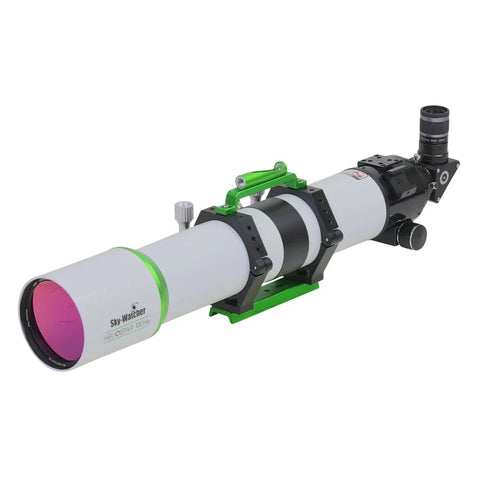
Most people have seen the Sun through a white-light filter: a plain white disk, maybe a sunspot or two. The Sky-Watcher Heliostar 100Ha is a different experience entirely. Tuned to the hydrogen-alpha (H-alpha, Hα) line at 656.3 nm, it opens up the Sun's chromosphere: towering prominences arcing off the limb, dark snaking filaments, bright plage around active regions, and the mottled texture of the solar surface. It's the closest most of us get to watching the Sun as a living, changing star, in real time, on any clear day of the year.
Double-stack contrast from a single etalon
Traditional H-alpha solar telescopes force a choice. A single etalon gives brighter views but softer surface contrast. A double-stack system tightens the bandpass for dramatic surface detail, but costs roughly 40% of your brightness and a lot more money.
Sky-Watcher's Solis etalon technology sidesteps that trade-off. The Heliostar 100Ha reaches a <0.55Å bandpass natively from a single etalon, giving the kind of high-contrast surface detail you'd normally need a double-stack to see, without the second filter, the brightness penalty or the price. The Trifid Tuner applies even pressure to the etalon at three points, so you can tune smoothly between prominence and surface detail as seeing conditions change.
100mm aperture for serious visual and imaging work
At 100mm and f/7.6 (760mm focal length), the Heliostar 100 resolves finer solar structure than the 76mm model, with about 73% more light-gathering area. The 20mm blocking filter in the 1.25" diagonal gives a large unvignetted field, and the 2.8" dual-speed rack-and-pinion focuser holds cameras and imaging trains securely while you fine-tune focus on the narrow H-alpha band.
Ready to observe the day it arrives
The Heliostar 100Ha is a complete kit, not a starting point you have to build onto. Everything ships in a rugged hard case:
- 100mm H-alpha optical tube with integrated Solis etalon and Trifid Tuner
- Mounting rings and carry handle
- V-style (Vixen-compatible) dovetail
- Heliostar solar finder, which makes safely locating the Sun easy
- 20mm, 1.25" H-alpha blocking filter diagonal
- 22mm 70° 1.25" eyepiece
- 2" eyepiece adapter
- Clip-on sun shade
- Hard-shell carrying case
For a complete grab-and-go solar setup, it pairs well with the Sky-Watcher Wave 100i mount, also available together as a Heliostar 100 and Wave 100i kit.
Built and tested for safe solar viewing
Each Heliostar 100Ha is tested on the actual Sun before it ships, and the design has been lab tested in the United States to the ISO 12312-2 solar viewing standard. The blocking filter in the supplied diagonal is part of the telescope's safety system, so always observe through it and never substitute a different diagonal.
This is a dedicated solar telescope and will not show anything other than the Sun. Please use an abundance of caution when observing the Sun, as incorrect use can cause serious and permanent eye damage.
Heliostar 100Ha FAQ
Can I image with the Heliostar 100Ha?
Yes. It's designed for both visual observing and imaging. Monochrome solar or planetary cameras are the usual choice, and the 20mm blocking filter supports larger sensors for full-disk shots.
What mount do I need?
The optical tube weighs 13.2 lbs and uses a V-style (Vixen-compatible) dovetail, so any mount rated for that load with a Vixen saddle will work. The Sky-Watcher Wave 100i is a popular match.
Heliostar 100Ha or Heliostar 76Ha?
The 100Ha offers higher resolution (1.16 vs. 1.52 arcseconds), about 73% more light gathering, a larger 20mm blocking filter (vs. 11.5mm) and a sturdier 2.8" rack-and-pinion focuser (vs. 2" Crayford). The 76Ha is lighter and less expensive. If imaging or high-magnification surface detail matters to you, the 100Ha is the stronger choice.
Why H-alpha instead of a white-light solar filter?
White-light filters show the photosphere: sunspots and limb darkening. H-alpha shows the chromosphere above it, where prominences, filaments, plage and flares are visible. The two are complementary, but H-alpha is where the Sun looks most dynamic.
Specifications
| Optical | |
|---|---|
| Optical design | Achromatic doublet |
| Lens coating | H-alpha fully multi-coated |
| Optical quality | Diffraction limited (1/4 wave) |
| Collimatable cell | No (self-aligning cell) |
| Aperture | 100mm |
| Focal length | 760mm |
| Focal ratio | f/7.6 |
| Bandpass | <0.55Å |
| Etalon | Solis single etalon with Trifid Tuner |
| Blocking filter | 20mm (1.25" diagonal) |
| Solar image size | 7.6mm |
| Mechanical | |
| Focuser | 2.8" dual-speed rack and pinion |
| Tube material | Aluminum |
| Tube length | 30" |
| Tube weight | 13.2 lbs |
| Mounting | Tube rings with V-style (Vixen) dovetail |
| Finder | Heliostar solar finder |
| Observational | |
| Dawes limit | 1.16 arcsec |
| Rayleigh limit | 1.4 arcsec |
| Magnification range | 14x to 197x |
| Magnification with included eyepiece | 35x |
| Light gathering vs. Heliostar 76Ha | About 73% more |
| Intended use | Solar visual and imaging |
| Manual | Digital PDF |
| SKU | S11325 |