



 Qualifies for Free Ground Economy Shipping (CONUS Only)
A full-frame astrograph that packs down to 9 inches and 3.4 pounds
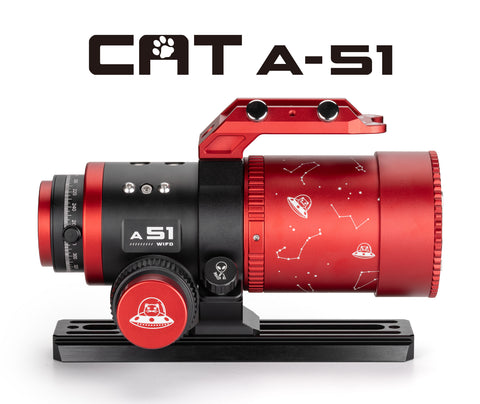
The William Optics Cat A-51 WIFD f/4.9 Astrograph is the 2027 version of the little 51 mm Petzval refractor that made the Cat series famous. It shoots wide nebula fields on a full-frame camera, works as a sharp travel scope for the Moon and planets, and doubles as a spotting scope for birds and wildlife by day. With the new retractable dew shield it is just 229.4 mm (9.0 in) long, and the optical tube weighs 1.53 kg (3.37 lb), small enough to ride on a star tracker and fit in a carry-on.
Key specs: 51 mm aperture · 250 mm focal length · f/4.9 · 4-element flat-field Petzval · 48 mm image circle (full frame) · WIFD rack-and-pinion focusing with 1:10 fine focus · built-in tilt adjuster and camera rotator · 1.53 kg (3.37 lb)

What you can image
At 250 mm the A-51 frames the big targets that longer scopes can't fit. A full-frame sensor covers about 8.3° × 5.5°; an APS-C camera such as the ZWO ASI2600MC Pro covers about 5.4° × 3.6° at 3.1"/pixel.
- The whole North America and Pelican Nebula complex (NGC 7000 / IC 5070) in one frame
- The Andromeda Galaxy (M31) with M32 and M110
- Orion's Sword with the Running Man, plus the Horsehead and Flame Nebulas
- The Heart and Soul Nebulas (IC 1805 / IC 1848) and the Rosette Nebula (NGC 2237)
- The Pleiades (M45) with its surrounding dust, and the Veil Nebula complex
- Rich Milky Way star fields in Cygnus, Sagittarius and Scorpius
What you'll see
- The whole Moon in one view, then its craters and mountains up close with a shorter eyepiece
- Jupiter's four Galilean moons and cloud belts, and Saturn's rings
- Bright open clusters such as the Pleiades and the Double Cluster in wide, sharp fields
- By day, birds and wildlife right side up with an erecting prism
Why it's easy to set up
- No flattener to buy or space. The four-element Petzval design is flat-field on its own, so you thread the included M48 adapter onto your camera and focus. Petzval designs focus over a range of back spacing rather than one exact distance; William Optics recommends 55 ± 3 mm for imaging.
- WIFD internal focusing. The lenses move inside the tube, so your camera or eyepiece doesn't move and the balance doesn't change as you focus. A two-speed focuser with 1:10 fine focus, a focus ruler scale and a temperature gauge on the knob make it easy to return to focus on cold nights.
- Bahtinov mask built into the lens cap. Pop off the outer cover and the lens cap becomes a Bahtinov mask for precise focus on a bright star.
- Built-in sensor tilt adjuster and camera angle rotator (CAA). Correct tilt and frame your target without loosening the camera.
- Anti-shrink lens cell. Keeps the lenses free of stress as temperatures drop, so stars stay round on cold Colorado nights.
- Ready to mount. The included 210 mm dual-side plate fits both Vixen-style and Arca-Swiss clamps, and the handle bar has a mini Vixen-style base for a guide scope or finder.
- Autofocus ready. The focuser knob comes off so you can attach a ZWO EAF with William Optics' EAF mounting bracket.
- Visual in seconds. For visual use, the erecting prism threads on in place of the rear camera adapter and takes standard 1.25" eyepieces.
What to add for the best results
- A camera (required for imaging). A cooled color camera like the ZWO ASI533MC Pro frames about 2.6° × 2.6°, perfect for the Rosette, Heart or Pleiades. To use a Canon or Nikon DSLR or mirrorless camera, add a Copper M48 Canon T-ring or Copper M48 Nikon T-ring.
- A mount (required). The A-51 is light enough for a star tracker such as the iOptron SkyGuider Pro or the Sky-Watcher Star Adventurer GTi GoTo Mount Kit.
- Autofocus: the ZWO EAFN Electronic Auto Focuser keeps focus as the temperature drops through the night. It attaches with the William Optics EAF mounting bracket for the A-51 (ask us). The A-51 has 15 mm of focus travel, so set your EAF travel limits before the first night.
- Guiding: the William Optics UniGuide 32 guide scope for longer, sharper exposures.
- Control: the ZWO ASIAIR Plus runs your camera, focuser, guiding and mount from your phone or tablet.
Cat A-51 vs. other small William Optics astrographs
| Cat A-51 WIFD | RedCat 51 III | MiniCat 51 | RedCat 61 | |
|---|---|---|---|---|
| Aperture | 51 mm | 51 mm | 51 mm | 61 mm |
| Focal length | 250 mm | 250 mm | 178 mm | 300 mm |
| Focal ratio | f/4.9 | f/4.9 | f/3.5 | f/4.9 |
| Retractable dew shield | Yes | No | No | No |
| Best for | Travel imaging plus visual and daytime use | Wide-field imaging on a budget | The widest, fastest fields | A little more reach for smaller nebulas |
See all of our William Optics Cat astrographs.
What's in the box

- Cat A-51 WIFD optical tube with retractable dew shield
- Lens cover with built-in Bahtinov mask
- M54 to M48 camera adapter with wrench
- Mounting ring and handle bar with mini Vixen-style base
- 210 mm dual-side dovetail plate (Vixen-style and Arca-Swiss)
- Allen key set
- A-51 soft carry case
The erecting prism, eyepieces, camera, T-ring, mount and tripod are sold separately.
Cat A-51 WIFD FAQ
Is the Cat A-51 good for beginners?
Yes. It is one of the simplest ways to start deep-sky imaging: no flattener, a forgiving back-spacing range, and a Bahtinov mask in the lens cap for easy focusing. Its light weight means a small star tracker is enough to carry it.
Can I see Saturn and Jupiter with it?
Yes. With an eyepiece you can see Saturn's rings and Jupiter's moons and cloud belts. It is a small 51 mm scope, so planets look small; it really shines on the Moon, star clusters and wide views.
How is the A-51 different from the 2024 Cat 51?
It is shorter and lighter: 229.4–266 mm long with the dew shield retracted or extended, and 1.53 kg (3.37 lb), compared with 298 mm and 1.77 kg (3.9 lb) for the 2024 Cat 51. It also has refined optics, upgraded lens coatings and the new anti-shrink lens cell.
What camera works best?
Any camera up to full frame. APS-C cameras like the ZWO ASI2600MC Pro give about a 5.4° × 3.6° field; smaller sensors like the ASI533MC Pro give a tighter 2.6° × 2.6° view. DSLRs and mirrorless cameras connect with an M48 T-ring.
What mount do I need?
For imaging, a tracking mount. At 1.53 kg for the tube, a star tracker such as the iOptron SkyGuider Pro or Sky-Watcher Star Adventurer GTi handles it easily, even with a camera and guide scope. For visual use or daytime viewing, a sturdy photo tripod with an Arca-Swiss head works.
Can I use it for both visual and astrophotography?
Yes. That is what the A-51 was designed for. Use it with a camera at night, then add an erecting prism and an eyepiece for the Moon, planets or birds. The soft carry bag holds the scope with the prism still attached.
Specifications
| Optics | |
|---|---|
| Optical design | 4-element Petzval, flat field |
| Aperture | 51 mm |
| Focal length | 250 mm |
| Focal ratio | f/4.9 |
| Image circle | 48 mm |
| Camera formats | Full frame, APS-C, Micro Four Thirds |
| Flattener | Not required |
| Lens cell | Anti-shrink cell for cold-weather performance |
| Focuser and camera | |
| Focuser | WIFD rack-and-pinion internal focuser, two-speed with 1:10 fine focus |
| Focus travel | 15 mm |
| Recommended back spacing | 55 ± 3 mm (imaging) |
| Focus aids | Focus ruler scale, temperature gauge on knob, Bahtinov mask lens cover |
| Autofocus | Focuser knob removable to attach an electronic autofocuser |
| Camera connection | M54 rear thread, M54 to M48 adapter included |
| Sensor tilt adjuster | Built in |
| Camera rotator | Built-in camera angle rotator (CAA) |
| Physical | |
| Length | 229.4 mm (9.0 in) dew shield retracted; 266 mm (10.5 in) extended |
| Dew shield travel | 36 mm, retractable |
| Height and width | 148.7 mm × 147.7 mm (5.9 × 5.8 in) with handle bar and plate |
| Weight | 1.53 kg (3.37 lb) optical tube; 2.2 kg (4.85 lb) total with ring, handle bar and plate |
| Mounting | Mounting ring, handle bar with mini Vixen-style base (M6 and M4 holes), 210 mm dual-side Vixen-style/Arca-Swiss plate (PRC210-A51) |
| Finder bracket | M4 screw holes on focuser body |
| Manufacturer | William Optics |