



Yes, our inventory is accurate!
 Qualifies for Free Ground Economy Shipping (CONUS Only)
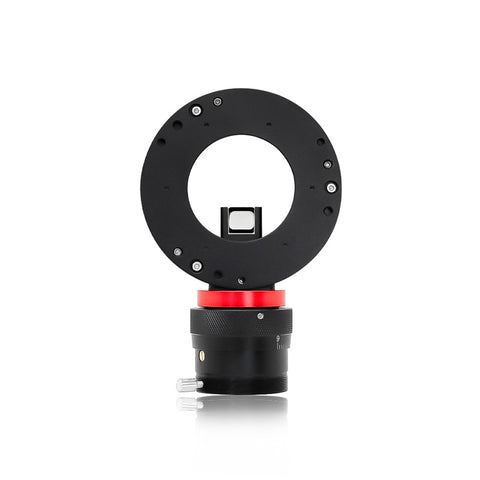
A large-prism off-axis guider for APS-C and full-frame cameras
Why we like the ZWO OAG-L:
- More guide stars at long focal lengths: the 12 × 12mm prism passes an 11.7 × 8.3mm patch of sky, more than twice the area of the standard ZWO OAG's 8mm prism, so the guide camera finds usable stars even at 700–1000mm.
- Fits ZWO's 55mm imaging train exactly: 5mm tilt plate + 17.5mm OAG-L + 20mm filter wheel + 12.5mm cooled camera adds up to 55mm, the back focus most flatteners and reducers need.
- No flexure between guide scope and main scope: it guides through the main telescope, which is what you want for long exposures on galaxies with a refractor over 100mm or an SCT.
- Worth knowing: it's built for APS-C and full-frame cameras behind a 2" or 36mm filter wheel. For a 4/3" or smaller camera, or a telescope with an M42 back, the smaller ZWO OAG is the better fit.
The ZWO OAG-L Large Off-Axis Guider sits between your telescope's flattener and your filter wheel and uses a small 12mm prism at the edge of the light path to feed a guide camera. Because the guide camera sees through the main telescope, there's no separate guide scope to flex or shift during the night. ZWO designed it for APS-C and full-frame cooled cameras such as the ASI2600MM Pro and ASI6200MM Pro, paired with a ZWO 2" or 7 × 36mm filter wheel. It weighs 265g (9.3oz).
Key specs: 12 × 12mm prism · 11.7 × 8.3mm effective guide aperture · 17.5mm thick (22.5mm with the included M48 tilt plate) · bolts directly to ZWO 2" and 36mm filter wheels · for ZWO ASI Mini guide cameras · 265g

When an off-axis guider makes sense
- Long focal lengths: on a 770mm ZWO FF110 or a 982mm ZWO FF131, a small guide scope can't sense small tracking errors well. An ASI174MM Mini on the OAG-L guides at about 1.6″ and 1.2″ per pixel on those scopes.
- SCTs and other mirror scopes: mirror shift can't be seen by a separate guide scope, but an OAG sees it and corrects it.
- Long narrowband subs: 5- to 10-minute exposures through 3nm to 7nm filters need steady, flexure-free guiding to keep stars round.
- A cleaner rig: no guide scope, rings or extra dovetail on top of the telescope.
How it works
A small prism sits just outside the main camera's light path and turns a slice of the image up into the guide camera. You focus the guide camera once with the OAG-L's helical focuser and lock it, and from then on it stays in focus whenever the main camera is focused.
The OAG-L has no inner threads. The telescope side takes a 5mm sensor tilt plate (an M48 plate is included, and ZWO makes M54 and M68 plates), and the camera side bolts straight to a ZWO 2" or 7 × 36mm filter wheel with screws. That keeps the train short and square:
- M48 tilt plate: 5mm
- OAG-L: 17.5mm
- ZWO 2" or 7 × 36mm EFW: 20mm
- ZWO APS-C or full-frame cooled camera (bolted to the EFW): 12.5mm
- Total: 55mm, the standard back focus for most flatteners and reducers

Set the guide camera so its sensor is the same distance from the prism as the main camera's sensor. It's easiest to do this in daylight on a distant object, then fine-tune on a star.
What to add for the best results
-
A guide camera (required): ZWO recommends its ASI Mini cameras with the OAG-L.
- ASI174MM Mini: its large 1/1.2" sensor and 5.86µm pixels make the most of the big prism, and it's the one we suggest for 700mm and up.
- ASI220MM Mini: very sensitive, a good all-round choice at a lower price.
- ASI120MM Mini: the budget option. It works, but its small sensor uses only part of the prism.
- A filter wheel: the ZWO 7-position 2" EFW, 5-position 2" EFW or 7 × 36mm EFW, which bolt directly to the OAG-L.
- A main camera: the ASI2600MM Pro, ASI2600MC Pro or full-frame ASI6200MM Pro.
- ASIAIR Plus: runs guiding, the camera, filter wheel and mount from your phone.
OAG-L vs. ZWO OAG vs. OAG-L-68
| ZWO OAG-L | ZWO OAG | ZWO OAG-L-68 | |
|---|---|---|---|
| Prism | 12 × 12mm | 8 × 8mm | 12 × 12mm |
| Effective guide aperture | 11.7 × 8.3mm | 7.4 × 5mm | 11.7 × 8.3mm |
| Thickness | 17.5mm | 16.5mm | 17.5mm |
| Main camera | Full-frame or smaller | APS-C or smaller | ASI461MM Pro medium format |
| Filter wheel | 2" EFW, 7 × 36mm EFW | 1.25", 2" and 36mm EFWs | ZWO 50mm square EFW |
| Weight | 265g | 181g | 277g |
| Best for | APS-C and full-frame trains at long focal lengths | 4/3" and smaller cameras, compact trains | The ASI461 medium-format system |
See all autoguiders for astrophotography.
What's in the box
- ZWO OAG-L off-axis guider with built-in helical guide camera focuser and 5mm M48 sensor tilt plate
- M3 brass screw
- Two M3 locking screws
- Four M2.5 × 6mm socket head screws
- Hex key
The guide camera, filter wheel and M54 or M68 tilt plates are sold separately.
ZWO OAG-L FAQ
OAG-L or the standard ZWO OAG?
Choose the OAG-L for an APS-C or full-frame camera with a 2" or 36mm filter wheel, especially at long focal lengths. Choose the ZWO OAG for a 4/3" or smaller camera such as the ASI533 or ASI294, or a telescope with an M42 back. Bigger isn't automatically better here: the OAG-L only pays off with a large main sensor.
Which guide camera should I use?
ZWO's ASI Mini cameras fit the OAG-L's guide port. The ASI174MM Mini has the largest sensor and suits the large prism best. The ASI220MM Mini is very sensitive at a lower price, and the ASI120MM Mini is the budget choice.
Will it fit my telescope?
The included M48 tilt plate fits flatteners and reducers with M48 threads, which covers most refractors. For M54 or M68 threads, swap in ZWO's matching tilt plate. ZWO doesn't recommend the OAG-L on telescopes with a back opening smaller than M48.
How does it affect back focus?
It takes 22.5mm of your back focus with the tilt plate. With a ZWO 2" or 36mm EFW (20mm) and a ZWO APS-C or full-frame cooled camera bolted to it (12.5mm), the total is exactly 55mm.
Will the prism shadow my main camera?
Set correctly, no. ZWO recommends checking that the prism doesn't intrude on the main sensor when you first assemble the train. Take a flat or a test frame and adjust the prism depth if you see a shadow at one edge.
Is it hard to focus the guide camera?
Do it once in daylight. Focus the main camera on a distant object, then adjust the OAG-L's helical focuser until the guide camera is sharp too, and lock it.
Specifications
| Optics | |
|---|---|
| Prism size | 12 × 12mm |
| Effective guide aperture | 11.7 × 8.3mm |
| Recommended main camera | ZWO ASI cameras up to full frame |
| Guide camera | ZWO ASI Mini cameras |
| Mechanical | |
| Optical path | 17.5mm; 22.5mm with the M48 tilt plate |
| Telescope side | 5mm M48 sensor tilt plate, built in (M54 and M68 plates available from ZWO) |
| Camera side | Bolts directly to ZWO 2" and 7 × 36mm EFWs (no inner threads) |
| Guide focuser | Helical, with lock screws |
| Height | 136mm minimum (guide focuser collapsed) |
| Weight | 265g (9.3oz) |
| Model / SKU | ZWO-OAG-L |