




Yes, our inventory is accurate!
 Qualifies for Free Ground Economy Shipping (CONUS Only)
A 3nm dual-band filter for emission nebulae from light-polluted skies
Why we like the L-Ultimate:
- Very narrow passbands: just 3nm wide at both hydrogen-alpha and oxygen III, less than half the width of the popular 7nm L-eXtreme. Less light pollution and skyglow get through, so faint nebula detail stands out from a darker background.
- Narrowband from a color camera: one filter on a one-shot-color camera gives you H-alpha and OIII data in a single exposure, ready for HOO-style color, without a filter wheel or mono camera.
- Clean stars: Optolong optimized the coatings to avoid obvious halos around bright stars, a common complaint with dual-band filters.
- Worth knowing: it's made for emission nebulae and supernova remnants. Galaxies, star clusters and reflection nebulae lose most of their light through it. With very fast optics, such as f/2 RASA systems, the light reaching the filter at steep angles can shift off such narrow passbands, so ask us before pairing it with very fast optics.
The Optolong L-Ultimate 3nm Dual-Band Filter passes only the red hydrogen-alpha and green-blue oxygen III light that emission nebulae give off, and blocks almost everything else, including light from mercury vapor and high- and low-pressure sodium streetlights and the natural airglow from oxygen in our atmosphere. It's the filter to choose when you image from the city or suburbs with a color astronomy camera and want the most contrast on nebulae. It comes in a 2" mounted version and a 1.25" mounted version.
Key specs: 3nm FWHM at H-alpha and OIII · blocking OD4 or better outside the passbands · peak transmission close to 90% at both lines in Optolong's curves · 1.85mm optical glass substrate · λ/4 transmitted wavefront (RMS) · 60/40 surface quality · 2" and 1.25" mounted

What you can image
- Supernova remnants: the Veil Nebula, Simeis 147 and W63 in Cygnus, where the oxygen filaments show up clearly in blue.
- Emission nebulae: the North America and Pelican, Heart and Soul, Rosette, Lagoon, Eagle and Lion (Sh2-132) Nebulae.
- Faint oxygen targets: the Squid Nebula (Ou4) inside the Flying Bat (Sh2-129), and the Crescent Nebula (NGC 6888) with its blue oxygen shell.
- Planetary nebulae: the Ring, Dumbbell and Helix Nebulae.

How to use it
Thread the 2" filter into a filter drawer, filter wheel or the front of your field flattener, or screw the 1.25" version onto a 1.25" nosepiece or into a 1.25" filter wheel. Focus with the filter in place, then expose longer than you would without it: the narrow passbands cut out so much light that several minutes per frame is normal. In processing, the red channel holds the H-alpha signal and the green and blue channels hold OIII, which makes HOO and bicolor palettes simple.
Because the passbands are so narrow, the L-Ultimate also lets you keep imaging nebulae when the Moon is up, when broadband imaging would be washed out.
Using it in Colorado
From Denver, Aurora or anywhere along the Front Range, skyglow swamps faint nebulae in an unfiltered image. The L-Ultimate makes backyard nebula imaging practical from the city, and under darker skies in the mountains it gives you even more contrast in the same time.
What to add for the best results
- A color astronomy camera: the ZWO ASI2600MC Pro (APS-C, use the 2" filter) or the ASI533MC Pro.
- A way to hold the filter: the ZWO M42 or M54 2" filter drawer, or the ZWO 5-position 2" filter wheel to switch between filters during the night.
- A telescope: a small refractor such as the RedCat 51 frames the large nebulae this filter is made for.
- Want SHO-style color? The Optolong L2 Dual-Combo Set pairs the L-eXtreme with the L-Synergy for sulfur II data too.
Optolong L-Pro vs. L-eNhance vs. L-eXtreme vs. L-Ultimate
| L-Pro | L-eNhance | L-eXtreme | L-Ultimate | |
|---|---|---|---|---|
| Type | Broadband light pollution | Tri-band | Dual-band, 7nm | Dual-band, 3nm |
| Color | Most natural | Nebula-weighted | H-alpha and OIII only | H-alpha and OIII only |
| Contrast on nebulae | Good | Better | High | Highest |
| Galaxies and clusters | Yes | Limited | No | No |
| Best for | Mixed targets under moderate light pollution | Brighter nebulae from the suburbs | Nebulae from the city, more light per exposure | Faint nebulae from bright skies, the most contrast |
See all astronomy filters.
What's in the box
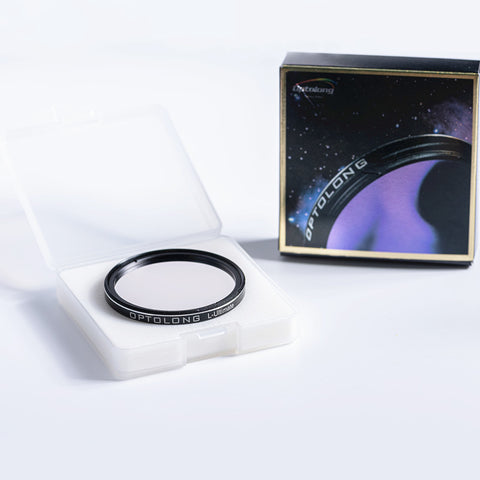
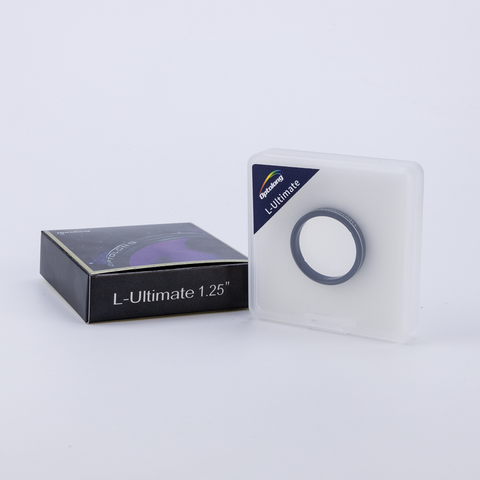
- Optolong L-Ultimate filter in a threaded cell (2" or 1.25", as selected)
- Plastic storage case with foam lining
- Optolong box
Cameras, filter drawers and filter wheels are sold separately.
Optolong L-Ultimate FAQ
Is the L-Ultimate good for beginners?
Yes, if you image nebulae with a color camera. It's a single filter that turns a light-polluted backyard into a usable imaging site. If you're just starting and want to image galaxies too, the L-Pro or no filter at all may suit you better at first.
L-Ultimate or L-eXtreme?
Both pass H-alpha and OIII. The L-Ultimate's 3nm passbands block more light pollution and give more contrast on faint nebulae. The 7nm L-eXtreme passes more light per exposure and is more forgiving, so it's a good all-round dual-band filter.
Which camera works best with it?
A cooled one-shot-color camera such as the ASI2600MC Pro or ASI533MC Pro. It also works with a modified DSLR or mirrorless camera, and with a mono camera when you want H-alpha and OIII captured together.
2" or 1.25"?
Choose 2" for APS-C and larger sensors such as the ASI2600MC, and 1.25" for small sensors and 1.25" filter wheels.
Can I use it for visual observing?
It isn't designed for visual use. The narrow passbands make the view very dim, and the eye is weak at H-alpha's deep red. For visual nebula viewing, a UHC or OIII filter is a better choice.
Specifications
| Optical | |
|---|---|
| Type | Dual narrowband (H-alpha and OIII) |
| Bandwidth (FWHM) | 3nm H-alpha + 3nm OIII |
| Peak transmission | Close to 90% at both lines (Optolong transmission curves) |
| Blocking | OD4 or better |
| Transmitted wavefront (RMS) | λ/4 |
| Surface quality | 60/40 |
| Parallelism | 30 arcseconds |
| Physical | |
| Substrate | Optical glass, 1.85mm thick |
| Sizes | 2" mounted; 1.25" mounted |
| Packaging | PP plastic case with EVA lining, cardboard box |
| SKU | L-Ultimate-2 (2"); L-Ultimate-1 (1.25") |