



Yes, our inventory is accurate!
 Qualifies for Free Ground Economy Shipping (CONUS Only)
Hubble-palette nebula images from a one-shot color camera
Why we like the Optolong L2 Dual-Combo:
- SHO without a mono camera: a color camera can't separate sulfur from hydrogen-alpha on its own, because both land on its red pixels. Shooting one night through each filter gives you separate SII, Hα and OIII data to combine into Hubble-palette color.
- Tight 7nm bands: each filter passes two 7nm windows and blocks over 99.9% of common light-pollution lines from 300 to 1000nm, so emission nebulae stand out from a city or suburban sky.
- Two filters, matched: the L-eXtreme and L-Synergy share the same OIII band, glass and thickness, so they focus alike and their data stack together cleanly.
- Worth knowing: these are for emission nebulae only; galaxies, star clusters and reflection nebulae need a broadband image. Optolong rates them for telescopes of f/3.3 or slower, so they're not for f/2 systems such as a RASA. You'll also need two sets of exposures per target, which roughly doubles the imaging time.
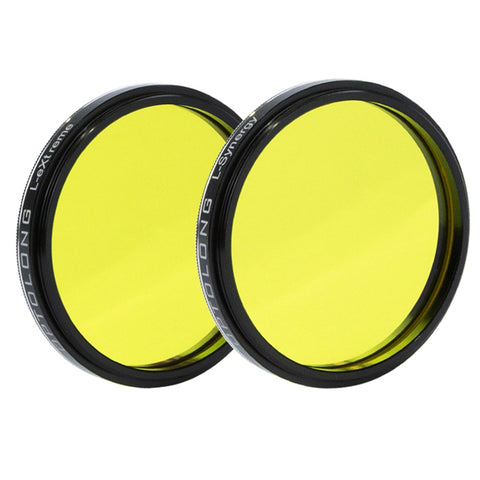
The Optolong L2 Dual-Combo Set includes two 2-inch dual-narrowband filters, the L-eXtreme (hydrogen-alpha and OIII) and the L-Synergy (SII and OIII), made to give one-shot color cameras and DSLRs the sulfur, hydrogen and oxygen data needed for Hubble-palette (SHO) images. It's for imagers with a cooled color camera such as the ZWO ASI2600MC Pro who want narrowband color without switching to a mono camera, a filter wheel and three separate filters.
Key specs: L-eXtreme: OIII 500.7nm + Hα 656.3nm, 7nm each · L-Synergy: OIII 500.7nm + SII 672.4nm, 7nm each · over 99.9% of light-pollution lines blocked, 300–1000nm · B270 glass, 1.85mm thick · λ/4 wavefront, 60/40 surface quality, 30″ parallelism · for f/3.3 and slower · 2" mounted filters

What you can image
- Bright emission nebulae in SHO color: the Eagle Nebula and its Pillars of Creation, the Rosette, the Lagoon and the Trifid, with sulfur showing as gold and oxygen as blue.
- Large nebula fields: the Heart and Soul, the North America and Pelican, and the Elephant's Trunk in IC 1396, where sulfur and oxygen trace different layers of gas.
- Supernova remnants: the Veil Nebula, where the OIII filaments are strong in both filters.
- The Crescent and Bubble Nebulae: smaller shells that pick up color differences in a longer focal length scope.
- Dual-band images on their own: the L-eXtreme alone gives a classic hydrogen-and-oxygen (HOO) image on nights when you only have time for one filter.
How it works
A color camera has red, green and blue pixels in a Bayer pattern. Hydrogen-alpha (656.3nm) and sulfur (672.4nm) are both deep red, so without filters they mix in the same red pixels, while OIII (500.7nm) lands in the green and blue pixels.
- Shoot through the L-eXtreme. The red pixels record only hydrogen-alpha, and the green and blue pixels record OIII.
- Shoot the same target through the L-Synergy. Now the red pixels record only sulfur, and green and blue record OIII again.
- Stack each set and combine. In Siril, PixInsight or similar software, take the red channel of each stack for SII and Hα, average the OIII from both, and assign them to red, green and blue for the Hubble palette.
The two red bands are 16nm apart and each is 7nm wide, so they stay cleanly separated, as Optolong's transmission chart shows. Put the filters in a 2-inch filter drawer or filter wheel between the telescope and camera, with your usual back-focus spacing.

What to add for the best results
- A color astronomy camera (required): the ZWO ASI2600MC Pro or ASI533MC Pro, the ASI2600MC Air with its built-in ASIAIR and guider, or the full-frame ASI6200MC Pro. A DSLR or mirrorless camera works too.
- ZWO M54 2" filter drawer with a spare Gen 2 filter holder, so each filter stays in its own holder and swapping takes seconds without touching focus.
- ZWO 5-position 2" filter wheel: changes between the two filters automatically from the ASIAIR or your capture software, so both can be captured on the same night.
- A telescope of f/3.3 or slower, such as the William Optics RedCat 51 III (f/4.9).
- ZWO EAFN electronic focuser: refocuses after each filter change and as the night cools.
L2 Dual-Combo vs. single Optolong nebula filters
| L2 Dual-Combo | L-eXtreme | L-Ultimate | L-eNhance | |
|---|---|---|---|---|
| Lines passed | Hα + OIII and SII + OIII (two filters) | Hα + OIII | Hα + OIII | Hα, Hβ and OIII |
| Bandwidth | 7nm | 7nm | 3nm | Wider tri-band |
| Captures sulfur (SII) | Yes | No | No | No |
| Images per target | Two sets | One | One | One |
| Best for | Hubble-palette color with a color camera | Hydrogen and oxygen nebulae from light-polluted skies | The most contrast on faint nebulae, even with the Moon up | A first nebula filter with more natural color |
See all astronomy filters.
What's in the box
- Optolong L-eXtreme 2" filter in a plastic case
- Optolong L-Synergy 2" filter in a plastic case
- Foam-lined Optolong gift box holding both filters
Already have a 2-inch L-eXtreme? The L-Synergy is also sold on its own. The camera, filter drawer or wheel and processing software are sold separately.
Optolong L2 Dual-Combo FAQ
Do I need a mono camera for Hubble-palette images?
Not with this set. Mono cameras with three narrowband filters are still the most efficient way to shoot SHO, but the L2 lets a color camera collect separate sulfur, hydrogen and oxygen data with just two filters.
Does it work with a DSLR?
Yes. Optolong designed the filters for DSLRs, color CMOS cameras and CCDs. An astro-modified DSLR records far more hydrogen-alpha and sulfur than a stock one, since stock DSLRs block most deep-red light.
Can I use these filters with a mono camera?
Yes, but a mono camera records both lines through each filter as one signal, so you can't separate Hα from OIII. With a mono camera, single narrowband filters such as the Optolong SHO set are the better choice.
Will it work on my fast telescope?
Optolong rates the L2 for f/3.3 and slower. Faster than that, the light passes through the filter at steeper angles and the narrow bands shift, so f/2 systems need filters made for them.
Is it good for galaxies?
No. Galaxies and star clusters shine across the whole spectrum, and these filters pass only a few narrow emission lines. Use no filter or a broadband filter for galaxies.
Do the two filters focus at the same point?
They're the same glass and thickness, so focus should be very close. Still, the red bands differ slightly, so we recommend refocusing after each change, which an electronic focuser does automatically.
Specifications
| L-eXtreme | |
|---|---|
| Passbands | OIII 500.7nm and Hα 656.3nm |
| Bandwidth (FWHM) | 7nm each |
| L-Synergy | |
| Passbands | OIII 500.7nm and SII 672.4nm |
| Bandwidth (FWHM) | 7nm each |
| Both filters | |
| Substrate | B270 glass |
| Thickness | 1.85mm |
| Blocking | 300–1000nm; light-pollution lines blocked over 99.9% |
| Transmitted wavefront | λ/4 RMS |
| Surface quality | 60/40 |
| Parallelism | 30″ |
| Coatings | Multi-layer anti-reflection; ion-assisted deposition, non-cemented |
| Recommended focal ratio | f/3.3 and slower |
| Size | 2" mounted |
| Packaging | Plastic case with EVA lining for each filter, in a foam-lined box |
| Model / SKU | L2 Dual-Combo Set |