



Yes, our inventory is accurate!
 Qualifies for Free Ground Economy Shipping (CONUS Only)
A full-frame color camera for the widest one-shot deep-sky images
Why we like the ASI6200MC Pro:
- Full frame in one shot: the 36 × 24mm IMX455 sensor covers 2.3 times the area of an APS-C sensor, and you get color in every frame without a filter wheel or separate filter sequences.
- Clean data: a true 16-bit ADC, up to 14 stops of dynamic range, a 51,400e⁻ full well and no amp glow keep bright star cores and faint nebulosity in the same exposure, and dark frames calibrate cleanly.
- Room to crop: 9576 × 6388 pixels of 3.76µm each, so a wide field still holds enough detail to frame a smaller target inside it.
- Worth knowing: a full-frame sensor needs a telescope with a flat image circle of about 44mm or more, and 2-inch filters if you use any. If your scope is built for APS-C, the ASI2600MC Pro gets the same pixel detail for well under half the price.
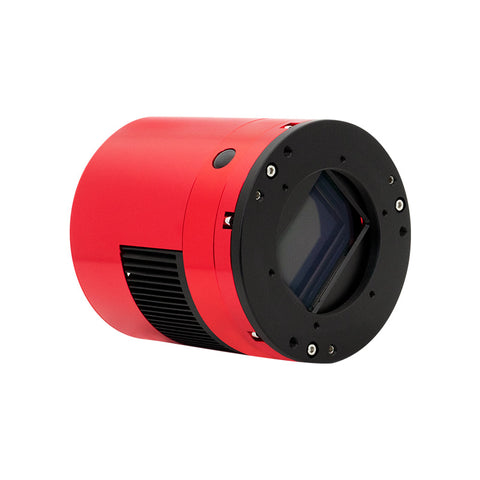
The ZWO ASI6200MC Pro (2025 model) is a cooled one-shot color astronomy camera built around Sony's back-illuminated full-frame IMX455 sensor, the color version of the ASI6200MM Pro. It's for imagers who want the widest field ZWO makes without moving to a mono workflow: point, expose, and every frame already holds color. Two-stage cooling holds the sensor 30–35°C below ambient, a heated window keeps dew off, and the body weighs 0.7kg (1.54lb).
Key specs: Sony IMX455 full-frame color sensor, 36 × 24mm · 9576 × 6388 (62MP class) · 3.76µm pixels · 16-bit ADC, up to 14 stops of dynamic range · 51.4ke⁻ full well · 80% peak QE · zero amp glow · two-stage cooling to 30–35°C below ambient · USB 3.0 with 512MB DDR3 buffer · 0.7kg (1.54lb)

What you can image
- Huge nebula regions in one frame: the Veil Nebula complex, Heart and Soul, the North America and Pelican, and the Rho Ophiuchi clouds. On a RedCat 51 the field is about 8.2° × 5.5°.
- Big galaxies with room around them: the Andromeda Galaxy with M32 and M110, M81 and M82 together, and the Leo Triplet. On the UltraCat 76 the field is about 5.6° × 3.8° at 2.1″ per pixel.
- Emission nebulae from the suburbs: with a dual-band filter such as the Optolong L-eXtreme, color cameras pull hydrogen-alpha and OIII from the Rosette, the Lagoon and Trifid, and the Elephant's Trunk under Front Range light pollution.
- Star clusters and comets: the Pleiades with their dust, the Double Cluster, and long comet tails, all in natural color with no filter changes.
How it works
The camera connects to a computer or an ASIAIR Plus over USB 3.0, and a 512MB DDR3 buffer keeps those large frames downloading reliably. The cooler and the camera itself run from a separate 12V supply: ZWO says all of its cooled cameras need external power to work, even with the cooler off. Two short USB 2.0 cables in the box let you plug a guide camera or electronic focuser into the camera instead of running more cables down to the mount.
ZWO designed the camera around the standard 55mm back focus. The 16.5mm and 21mm extenders in the box, together with the camera's own depth, get you there for most flatteners and astrographs, and the sensor's tilt can be adjusted with three pairs of push-pull screws. Because it's a color sensor, you can image with no filter at all from a dark site, or add a single 2-inch light-pollution filter in a filter drawer from home.

What to add for the best results
- 12V power (required): the ZWO 12V 5A adapter at home, or the 12V 10A adapter if it also powers your mount and controller. In the field, a 12V battery such as the Celestron PowerTank Lithium Pro.
- A full-frame telescope (required): one with a flat image circle of about 44mm or more, such as the William Optics RedCat 51 III (48mm) or UltraCat 76 (50mm).
- ZWO M54 2" filter drawer with a light-pollution filter: the Optolong L-eXtreme or L-Ultimate for emission nebulae, the Optolong L2 Dual-Combo for Hubble-palette color, or the L-eNhance as a broader all-rounder.
- ZWO OAG-L off-axis guider with an ASI220MM Mini: its 12mm prism suits large sensors and guides through the main telescope.
- ZWO EAFN electronic focuser: refocuses automatically as the temperature drops, which matters on a large, fast sensor.
- ASIAIR Plus: runs the camera, mount, guiding and focuser from your phone or tablet.
- A mount: the ZWO AM5N for small and mid-size refractors with this camera, or the ZWO AM7 for larger scopes.
ASI6200MC Pro vs. ASI6200MM Pro vs. ASI2600MC Pro
| ASI6200MC Pro (2025) | ASI6200MM Pro (2025) | ASI2600MC Pro (2025) | |
|---|---|---|---|
| Sensor | IMX455 color, full frame | IMX455 mono, full frame | IMX571 color, APS-C |
| Sensor size | 36 × 24mm | 36 × 24mm | 23.5 × 15.7mm |
| Resolution | 9576 × 6388 | 9576 × 6388 | 6248 × 4176 |
| Pixel size | 3.76µm | 3.76µm | 3.76µm |
| Peak QE | 80% | 91% | 80% |
| Filters needed | None (2" light-pollution filter optional) | 2" filters and a filter wheel | None (dual-band optional) |
| Image circle needed | About 44mm or more | About 44mm or more | About 28mm or more |
| Best for | The widest field in color, with the simplest workflow | The widest field with narrowband and LRGB | Color imaging on most refractors, for much less |
See all ZWO cooled deep-sky cameras.
What's in the box
- ASI6200MC Pro camera body and front cover
- T2-M48 extender (16.5mm), M54-M48 extender (21mm) and M48-M42 adapter
- USB 3.0 cable (2m) and two USB 2.0 cables (0.5m)
- Hex wrench, quick guide and padded camera bag
The 12V power supply, filters, filter drawer and guide camera are sold separately.
ZWO ASI6200MC Pro FAQ
Is the ASI6200MC Pro good for beginners?
The camera itself is as easy to run as any ZWO color camera, since there are no filters to manage. The harder part is the rest of the setup: it needs a full-frame telescope, careful spacing and a mount to match. If this is your first cooled camera, we usually suggest the ASI2600MC Pro, and the ASI6200MC Pro once you're ready for a full-frame scope.
ASI6200MC Pro or ASI6200MM Pro?
Same sensor size and pixels. The color MC captures a full-color image in every frame, so a night out gives you a finished image with the least processing. The ASI6200MM Pro is more sensitive (91% vs. 80% peak QE) and is the better choice for narrowband from light-polluted skies, but it needs a filter wheel, 2-inch filters and more processing.
ASI6200MC Pro or ASI2600MC Pro?
Both use 3.76µm pixels, so detail per pixel is the same. The ASI6200MC Pro covers 2.3 times more sky on the same telescope, but needs a full-frame image circle. The ASI2600MC Pro costs much less and works on almost any imaging refractor.
Can I shoot narrowband with a color camera?
Yes, with dual-band filters. The Optolong L-eXtreme passes hydrogen-alpha and OIII, and the L2 Dual-Combo adds an SII and OIII filter so you can build Hubble-palette images. Use 2-inch filters to cover the full-frame sensor.
What power does it need?
ZWO recommends a 12V DC supply of 3–5A (5.5 × 2.1mm plug, center positive) or a lithium battery between 11 and 14V. The camera won't run on USB power alone, even with the cooler off. ZWO warns that voltage outside that range can damage the camera.
Can I use it without a computer?
Yes, with an ASIAIR Plus. It runs the camera, mount, guiding and focuser from a phone or tablet.
Specifications
| Sensor | |
|---|---|
| Sensor | Sony IMX455, back-illuminated, color |
| Format | Full frame, 36 × 24mm (43.3mm diagonal) |
| Resolution | 9576 × 6388 (61.2 million pixels) |
| Pixel size | 3.76µm |
| ADC | 16-bit |
| Dynamic range | Up to 14 stops |
| Full well | 51,400e⁻ |
| Peak QE | 80% |
| Amp glow | None |
| Performance | |
| Cooling | Two-stage TEC, 30–35°C below ambient (35°C measured at 30°C ambient) |
| Anti-dew | Polyimide heater on the protective window, switchable |
| Sensor adjustment | Three pairs of push-pull screws |
| Physical and connections | |
| Data | USB 3.0 with 512MB DDR3 buffer |
| Power | 12V DC, 3–5A, 5.5 × 2.1mm center positive, or an 11–14V lithium battery (not included) |
| Back focus | Designed for 55mm with the included extenders |
| Weight | 0.7kg (1.54lb) |
| Warranty | 2 years (ZWO) |
| Model / SKU | ASI6200MC-P25 / ZWO-ASI6200MC-P25 |