



 Qualifies for Free Ground Economy Shipping (CONUS Only)
A 130mm astrograph that covers medium-format sensors with no flattener to space
Why we like the Askar SQA130:
- Aperture without the slow focal ratio: 130mm at f/4.8 gathers almost 3.5 times the light of a 70mm scope at the same speed, so faint galaxies and nebulae build up quickly in each hour of imaging.
- A big, even field: the flattener is part of the five-element Petzval design, and Askar's design data shows over 95% illumination at the edge of a 44mm full-frame circle and over 85% at 55mm. Full-frame cameras such as the ASI6200 see very little vignetting.
- Forgiving back focus: anywhere from 46mm to 76mm behind the adapter comes to focus, so you can add an off-axis guider or filter drawer without precise spacer math.
- Worth knowing: this is a heavy telescope. It weighs 9.18kg (20.2lb) on its own and 11.76kg (25.9lb) with its rings and plate, before a camera. Plan on a mount like the ZWO AM7. It's an astrograph built for cameras, not a visual telescope.
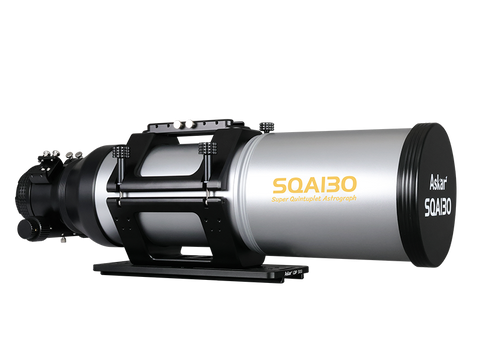
The Askar SQA130 130mm f/4.8 Quintuplet APO Astrograph is the largest telescope in Askar's SQA series. Its air-spaced Petzval design uses five lenses, two of them SD (special dispersion) glass, and builds the field flattener into the optics. The 624mm focal length frames galaxies, mid-sized nebulae and star clusters with plenty of detail, and the 55mm image circle covers full-frame and larger sensors. It comes with integrated tube rings, a 300mm Losmandy-style dovetail plate, a 3.2" dual-speed focuser with a 360° rotator, and an Oxford cloth carry case.
Key specs: 130mm aperture · 624mm focal length, f/4.8 · 5-element air-spaced Petzval with 2 SD elements · 55mm image circle (covers 44mm full frame) · 46–76mm back focus range, 55mm recommended · 3.2" dual-speed rack-and-pinion focuser, 30mm travel · 9.18kg (20.2lb) tube; 11.76kg (25.9lb) with rings and plate

What you can image
- Galaxies: M81 and M82 together, the Triangulum Galaxy, the Whirlpool Galaxy (M51), M101, the Leo Triplet and the Sculptor Galaxy (NGC 253).
- Mid-sized nebulae: the Orion Nebula with the Running Man, the Eagle Nebula (M16), the Lagoon and Trifid Nebulae, the Crescent Nebula and the Iris Nebula.
- Nebula details: the Pillars of Creation region, the Horsehead and Flame Nebulae, the Elephant's Trunk in IC 1396 and sections of the Veil Nebula.
- Clusters: the Pleiades with their reflection nebulosity, the Double Cluster and globulars such as M13.
With an ASI2600 (APS-C) camera, the SQA130 frames 2.16° × 1.44° at 1.24″ per pixel. With a full-frame ASI6200 it frames 3.30° × 2.20° at the same image scale, wide enough for the whole Orion Nebula region or M81 and M82 with room around them.
How it works
No flattener to space: the field flattening is built into the optics, so there's no separate flattener and no single critical spacing. Askar's connection diagram shows a ZWO cooled camera (17.5mm back focus) reaching the recommended 55mm with the M48 extension tubes that come with ZWO cameras, or with an off-axis guider and filter drawer in their place. Anything between 46mm and 76mm comes to focus.
Adapters: the focuser ends in an M76 thread with step adapters for M68, M54 and M48 cameras and accessories, so most astronomy cameras, filter wheels and full-frame camera adapters thread straight on.
Focuser and rotator: the 3.2" dual-speed rack-and-pinion focuser has 30mm of travel with a scale on the drawtube. A 360° rotator with a scale and an enlarged locking screw lets you frame a target and return to the same angle later. Askar says it works with most electronic focusers, which mount on a bracket using threaded holes under the focuser.
Mounting: the integrated tube rings have M4 and M6 threaded holes on both sides for accessories or a guide scope, and the top handle doubles as a finder base. Two more finder bases sit beside the focuser.

What to add for the best results
- A mount (required): the ZWO AM7 with TC40 tripod carries 20kg (44lb) without a counterweight, comfortable for the SQA130 with a full-frame camera, guider and focuser. The ZWO AM5N carries 15kg (33lb) without a counterweight and 20kg (44lb) with one; with the SQA130 it's close to its no-counterweight limit, so use the counterweight.
- A camera (required): a full-frame ZWO ASI6200MM Pro or ASI6200MC Pro uses the whole corrected field. An APS-C ASI2600MC Pro or ASI2600MM Pro gives a closer 2.16° × 1.44° view.
- Guiding: the ZWO OAG-L has a 12mm prism sized for full-frame sensors, paired with an ASI220MM Mini guide camera. Or mount Askar's 52mm Super ED guide scope on the handle.
- Autofocus: a ZWO EAFN or EAF Pro keeps focus as the temperature drops, which matters at 624mm.
- Control: the ZWO ASIAIR Plus runs the camera, mount, focuser and guiding from your phone or tablet.
- Filters: Askar's Colour Magic C 2" duo-band filter package or a 2" ZWO Duo-Band filter in a ZWO M54 2" filter drawer for nebulae from light-polluted skies, or a ZWO 7-position 2" filter wheel for a mono camera.
- SQA accessories: the SQA Series 20mm riser blocks lift the telescope for more camera clearance on an equatorial mount, and the SQA Series handle bar makes it easier to carry.
Which SQA astrograph is right for you?
| SQA55 | SQA60 Pro | SQA70 | SQA85 | SQA106 | SQA130 | |
|---|---|---|---|---|---|---|
| Aperture / focal length | 55mm / 264mm | 60mm / 276mm | 70mm / 336mm | 85mm / 408mm | 106mm / 509mm | 130mm / 624mm |
| Focal ratio | f/4.8 | f/4.6 | f/4.8 | f/4.8 | f/4.8 | f/4.8 |
| Optics | 5 elements, 1 SD + 1 ED | 6 elements, 2 SD | 5 elements, 2 ED | 5 elements, 2 SD | 5 elements, 2 SD | 5 elements, 2 SD |
| Image circle | 44mm | 44mm | 44mm | 44mm | 55mm | 55mm |
| Field with ASI2600 (APS-C) | 5.10° × 3.41° | 4.88° × 3.26° | 4.01° × 2.68° | 3.30° × 2.20° | 2.64° × 1.77° | 2.16° × 1.44° |
| Weight with rings and plate | 2.18kg (4.8lb) | 3.54kg (7.8lb) | 3.5kg (7.7lb) | 4.62kg (10.2lb) | 8.12kg (17.9lb) | 11.76kg (25.9lb) |
| Best for | The lightest travel setup; also works as a camera lens | Wide fields on a small mount, with a front filter thread | Large nebulae on a compact mount | The all-rounder for nebulae and big galaxies | Galaxies and nebulae on full frame with a mid-size mount | The most detail on galaxies and small nebulae |
See all Askar telescopes and accessories.
What's in the box
- Askar SQA130 optical tube with integrated tube rings, handle and dew shield
- 300mm Losmandy-style dovetail plate
- M68, M54 and M48 step adapters on the focuser's M76 thread
- Front lens cap
- Oxford cloth carry case
The mount, camera, guider, electronic focuser and filters are sold separately.
Askar SQA130 FAQ
Is the SQA130 a good first astrophotography telescope?
Usually not. Its size and 624mm focal length need a strong mount, accurate polar alignment and good guiding. Most people start with a smaller scope such as the SQA70 or SQA85 and move up once they're comfortable. If you already image with a smaller refractor, the SQA130 is a natural next step.
What mount do I need?
With a camera, guider and focuser, plan on roughly 13–14kg (29–31lb) on the mount. The ZWO AM7 handles that without a counterweight. The AM5N works with its counterweight added. We're happy to check your setup with you.
Do I need a field flattener?
No. The flattener is built into the five-element design. Set your camera anywhere from 46mm to 76mm behind the adapter (55mm recommended) and focus.
Which camera works best?
A full-frame camera such as the ASI6200MM Pro uses the whole field, and 3.76µm pixels give 1.24″ per pixel, a good match for typical seeing. An APS-C ASI2600MC Pro works very well too, with a tighter field.
SQA130 or SQA106?
The SQA130 has 50% more light-gathering area and a 624mm focal length for more detail on galaxies. The SQA106 has the same 55mm image circle and f/4.8, frames 2.64° × 1.77° on APS-C, and at 8.12kg (17.9lb) with rings and plate fits a ZWO AM5N without a counterweight.
Can I use it for visual observing?
Askar designs the SQA series as astrographs, and all of Askar's connection diagrams for the SQA130 are for cameras. If visual use matters to you, ask us before you buy.
Does it work with an electronic focuser?
Yes. Askar says the focuser works with most electronic focusers, and its assembly diagrams show one mounted under the focuser on a bracket, with a 5–6mm flexible coupling on the coarse-focus shaft. The ZWO EAFN is a common choice.
Specifications
| Optics | |
|---|---|
| Optical design | Quintuplet air-spaced Petzval APO, 2 SD glass elements |
| Aperture | 130mm |
| Focal length / ratio | 624mm, f/4.8 |
| Image circle | 55mm (medium format); covers 44mm full frame |
| Relative illumination (design) | Over 95% at 44mm; over 85% at 55mm |
| Spot size (design, RMS radius) | Under 2µm at center; under 2.4µm at the edge of the 55mm circle |
| Mechanical | |
| Focuser | 3.2" dual-speed rack and pinion, 30mm travel, engraved scale |
| Rotator | 360° with scale and locking screw |
| Camera connection | M76 with M68, M54 and M48 adapters |
| Back focus | 46–76mm from the adapter; 55mm recommended |
| Mounting | Integrated tube rings with handle; 300mm Losmandy-style dovetail plate; two finder bases at the focuser |
| Physical | |
| Length | 650mm (25.6 in) with dew shield retracted; 764mm (30.1 in) extended |
| Tube diameter | 168mm; 180mm at the dew shield |
| Weight | 9.18kg (20.2lb) tube; 11.76kg (25.9lb) with tube rings and dovetail plate |
| Case | Oxford cloth carry case |
| Manufacturer model | Askar SQA130 |